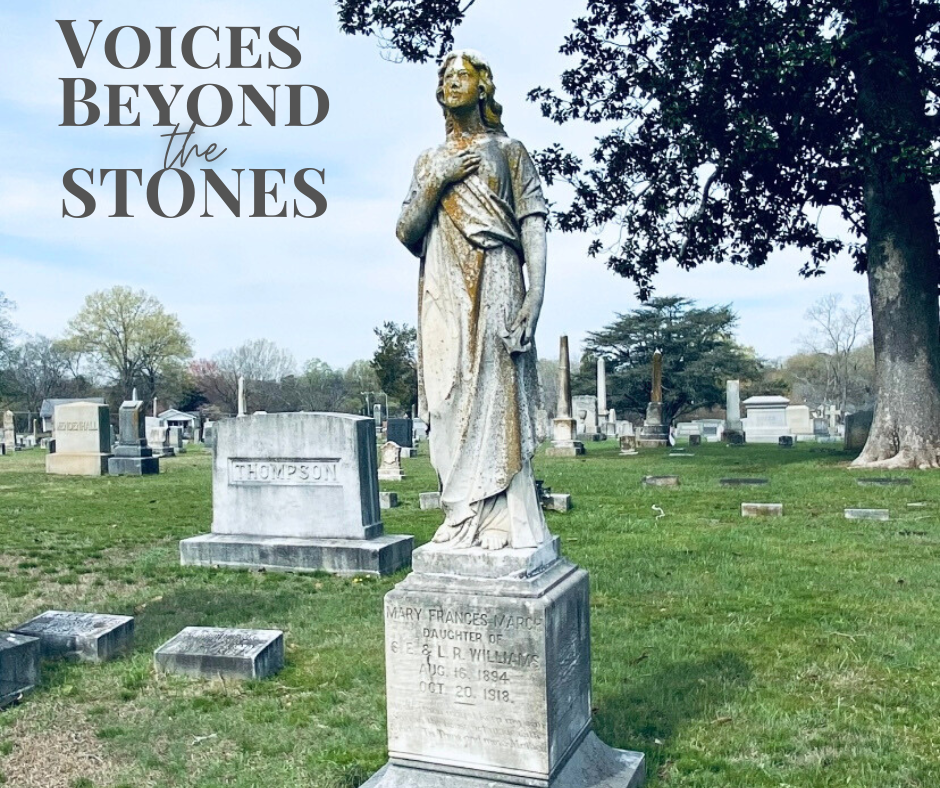
Series: Lexington's Angel
This is the first installment of Davidson Local’s new series, Voices Beyond the Stones. Over the coming weeks, Caleb Sink invites you to tag along for a journey through the Lexington City Cemetery, uncovering the stories of those who rest there.
There was a chill in the air the day I wandered through the Lexington City Cemetery, trying to squeeze in a few minutes of exercise during my lunch break. I made my way up from the bottom of the hill toward the “old part” of the cemetery, the section where my third-great grandparents rest with Lexington’s founding families.
I wasn’t searching for any stone in particular, but a woman, an angel, you might say, caught my eye.
The woman of stone stands tall with her weathered hand upon her heart, looking up toward the heavens. She serves as a lasting memorial to a young woman whose promising future was cut short by one of the deadliest illnesses of the early twentieth century.
To her family and friends, she was simply Frances. But to folks like me who casually walk past her grave, her name was Mary Frances March Williams. She was born Aug. 16, 1894, and died Oct. 20, 1918, at barely 24 years old.
The daughter of an attorney father and an ever-popular mother, Frances was born into a family akin to Lexington royalty. Even before her birth, her father, S.E. Williams, had served at least one term as mayor. Her mother, Luna, was already well established as a leader in local ladies’ social circles. Life for a young Frances at her family’s large home on West First Avenue must have been filled with all of the luxuries those days could afford.
A Dispatch writer describes Frances as being “refined, cultured, and well educated,” having been educated at Randolph-Macon College, the prestigious United Methodist college in Ashland, Virginia. Beyond her refinement, she was a woman with a kind heart. “She was a sweet, attractive, young woman,” a reporter wrote. “An affectionate daughter and a faithful member of the Methodist church.”
The Williams family moved to Winston-Salem in the fall of 1918, just as the Spanish flu began to spread across North Carolina. Hardly six weeks would pass before Frances was herself afflicted with the illness. On an October Sunday afternoon, a mere five days after she contracted the flu, she was dead.
Newspaper accounts indicate that her mother, who was already not well, experienced immense grief over her loss. It’s a pain that remains visible, ever so slightly, even today, over a century later, through the engraved words of her mother on her gravestone.
“Master, thou mayst keep my gem safe in the house not made with hands. ‘Tis Thine and mine.
—Mother”
Frances’ obituary tells how her friends covered her grave with flowers in the days after her death. And today, though her grave lies bare, she is remembered by an angel standing tall, keeping watch over the Lexington City Cemetery.