
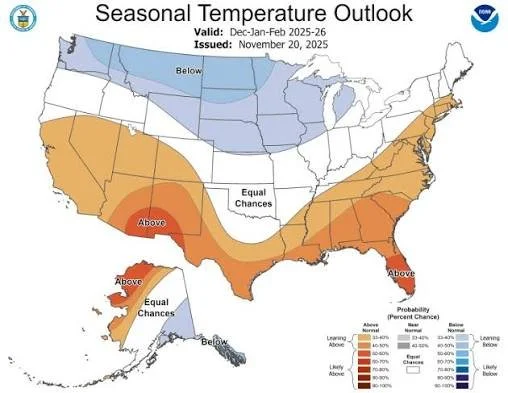
El Nino projected to impact most counties this winter
El Niño is coming for North Carolina like a slow‑rolling atmospheric tide, warm Pacific water tilting the jet stream, rewriting our seasonal rhythms, and reminding this state that weather is never just weather. It’s politics, agriculture, fisheries, and the daily lives of people who’ve learned to live between drought and deluge.
El Niño and the Carolinas: A Season of Tilted Skies
North Carolina has always lived at the mercy of water, either too much, too little, but never evenly distributed. But this year’s El Niño isn’t just another climate pattern drifting across the Pacific. NOAA says there’s a greater than 90% chance this event becomes very strong, and nearly a 70% chance it reaches an intensity unmatched in records going back to 1950.
That’s not background noise. That’s a tectonic shift in the atmosphere.
Warm water is pooling across the equatorial Pacific, weakening the trade winds that normally keep the ocean’s heat pinned to the west. As that warmth spreads eastward, it tugs on the jet stream like a rope, pulling storms into new corridors, suppressing hurricanes, and loading the southeastern sky with moisture.
In North Carolina, that means the seasons ahead won’t behave.
Hurricane Season: A Strange Kind of Mercy
El Niño is a hurricane killer, not by cooling the Atlantic, but by shredding storms with vertical wind shear, the hostile upper‑level winds that tilt and tear apart developing cyclones.
Even with Atlantic waters running hot, NOAA expects a below‑normal hurricane season for the Carolinas.
But “below normal” doesn’t mean “safe.”
It means fewer storms, not fewer landfalls. One well‑aimed hurricane can still carve its name into the coastline.
Still, for a state that has endured Florence, Matthew, and Fran, a quieter season is a rare gift, even if it’s delivered by a climate pattern that will demand repayment later.
Fall: The Moisture Freight Train Arrives
By late fall, the Pacific’s warmth begins to pump moisture into the Southeast. NOAA forecasters expect above‑normal rainfall across most of North Carolina, a direct consequence of El Niño’s global circulation shift.
This isn’t the gentle kind of rain that replenishes wells and quiets dust.
It’s the long, soaking kind, the kind that turns soybean fields into sponges, that pushes creeks past their banks, that tests the patience of anyone living near a floodplain.
For counties already strained by drought, this is relief.
For counties with aging stormwater systems, it’s a warning.
Winter: The Wet Season Returns With Teeth
North Carolina winters during strong El Niño years follow a pattern: wetter, stormier, and more persistent rainfall. Meteorologists say we can expect more winter precipitation statewide, especially after months of drought have thinned reservoirs and stressed water supplies.
Historical data backs it up. In the seven strongest El Niño winters since 1950, 70 of 100 NC counties saw heavier‑than‑normal winter rain in at least five of those events.
That’s not a fluke.
That’s a climate fingerprint.
For the Piedmont, it means cold rain that settles in for days.
For the mountains, it means more winter storms riding the jet stream.
For the coast, it means saturated ground and higher flood risk, even without hurricanes.
What This Means for North Carolina
Agriculture
Rain is both lifeline and threat. Winter‑wet soils can delay planting, drown seedlings, and complicate harvest schedules. Farmers who’ve already battled drought will now face the opposite problem, too much water, too fast.
Infrastructure
Stormwater systems built for 20th‑century rainfall patterns will be stress‑tested by 21st‑century extremes. Flood insurance policies, which take 30 days to activate, will matter more than ever.
Coastal Communities
Fewer hurricanes this season doesn’t mean fewer floods. El Niño’s moisture pipeline can trigger repeated coastal flooding, especially in places where sea level rise has already turned high tides into hazards.
The Atmosphere Doesn’t Ask Permission
El Niño is not a storm.
It’s a shift in the planet’s breathing, a redistribution of heat that ripples outward until it touches every county in North Carolina.
This year, that breath is warm, heavy, and insistent.
It will quiet the hurricanes.
It will soak the fields.
It will test the rivers.
It will remind the Carolinas that climate is not a distant abstraction, it’s the shape of our seasons, the rhythm of our work, the stories we tell about the land we live on.
And this year, the story is changing.
