Permit for SSEP pipeline approved; Davidson County among local governments opposing project
The U.S. Army Corps of Engineers has issued a federal permit for the Southeast Supply Enhancement Project (SSEP), an interstate natural gas pipeline proposed by Transcontinental Gas Pipe Line Company, LLC (Transco). The permit, issued under Section 404 of the Clean Water Act, authorizes the company to cut crossings through more than 150 streams and wetlands along the project route.
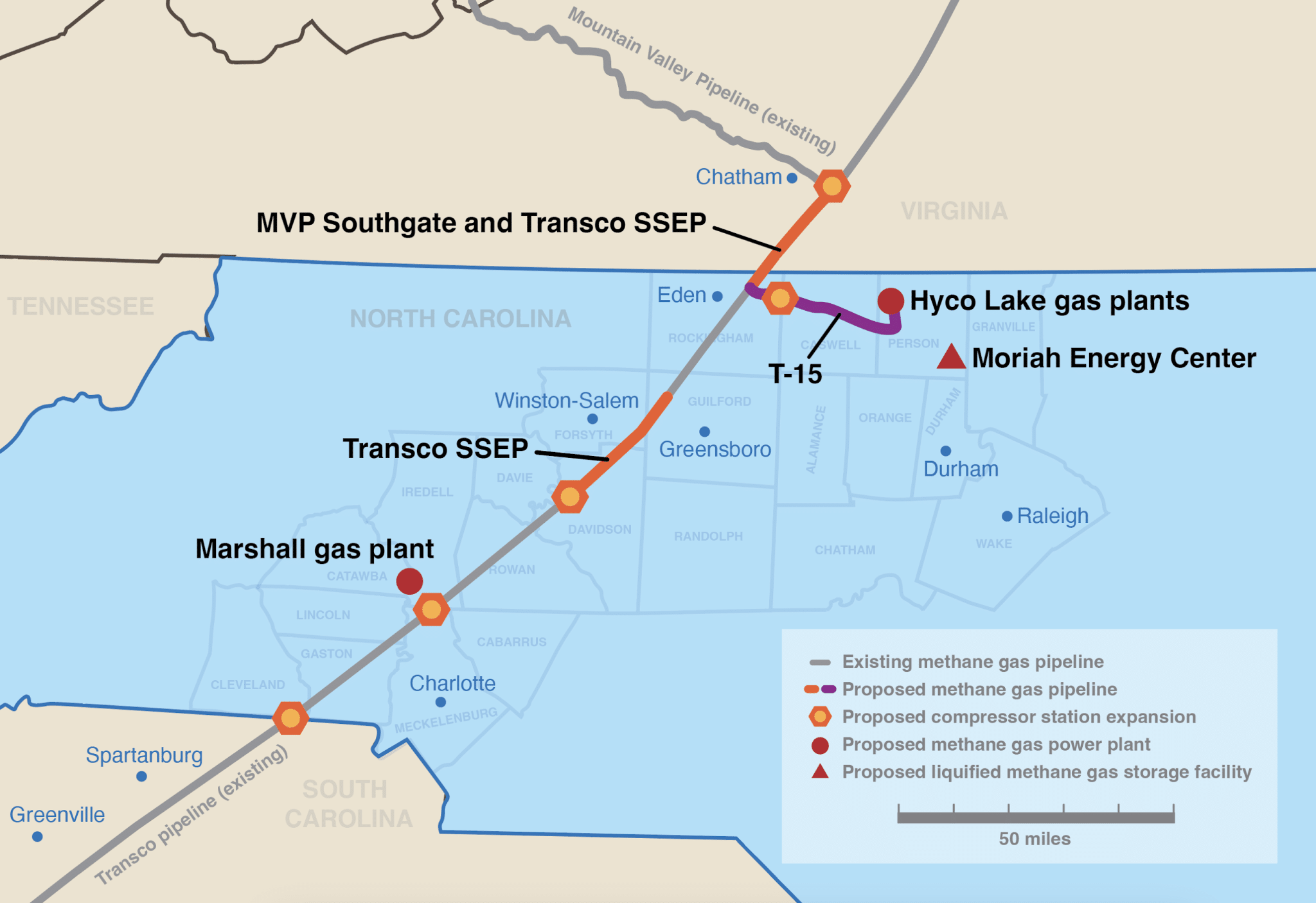
The SSEP pipeline expansion would run between Pittsylvania County, Virginia and Coosa County, Alabama. Plans include 26.4 miles of new pipe in Pittsylvania County and 28.4 miles of new pipe across Rockingham, Guilford, Forsyth and Davidson counties in North Carolina.
The proposal also calls for expanding emissions-producing gas-fired compressor units in Iredell and Davidson counties, as well as updates to compressor stations in Anderson County, South Carolina, Walton and Henry counties in Georgia and Coosa County, Alabama.
Most of the new pipe would be installed alongside existing Transco pipelines. Portions of the route overlap with areas previously proposed for the Mountain Valley Pipeline Southgate extension. The co-location of multiple high-pressure, large-diameter pipelines has raised concerns among residents in impacted communities.
In North Carolina, six municipal governments have passed resolutions opposing or expressing concern about the project. Those include the cities of Greensboro, Lexington and Midway, along with Forsyth, Davidson and Guilford counties. Davidson County officials and several local municipalities have cited potential environmental risks, impacts to waterways and broader community concerns in their opposition statements.
Environmental and community advocacy groups sharply criticized the Corps’ decision.
“The U.S. Army Corps of Engineers decided to issue a Clean Water Act permit for the Southeast Supply Enhancement Project, but the public has not yet had the opportunity to see the Corps’ full explanation for why they issued it,” said Juhi Modi, North Carolina Program Coordinator for Appalachian Voices. “Unsurprisingly, Transco is rushing ahead and has asked FERC to allow it to start trenching through the region’s fields, forests, and streams. We are disappointed that the Corps appears once more to have fallen short of its duty to protect sensitive waterways and ecosystems from this sort of disruption by issuing the permit.”
David Sligh, Wild Virginia’s Water Quality Program Director, questioned the federal government’s approach to water protections.
“We’ve relied on the protections promised in the historic Clean Water Act of 1972 for more than 50 years, but those protections are under unprecedented attack by the current federal administration,” Sligh said. “The Army Corps of Engineers’ action, in rubbler-stamping Transco’s plan to cut and blast through our streams and wetlands, is in line with that approach. The proposed assault on our communities and resources, and the Corps’ approval of it, is deplorable.”
Caroline Hansley, Campaign Organizing Strategist for the Sierra Club, said residents and elected officials along the route have spoken out against the project.
“By approving SSEP, the U.S. Army Corps has placed corporate pipeline profits over the health of our streams and the well-being of impacted communities,” Hansley said. “Residents, businesses, and elected officials along the route of SSEP have spoken out against this dangerous pipeline. Transco should not be allowed to move forward with construction, damaging our waterways and communities for an unnecessary pipeline.”
Buck Purgason, a North Carolina fisherman, voiced concerns about potential sediment impacts on the Dan River.
“This is another deadly blow to the fish and other aquatic life that call the Dan River home,” Purgason said. “This unwanted and unnecessary pipeline means more sediment flowing into a river that has been devastated by a coal ash spill just 11 years ago, where only ten percent of the ash was recovered. The continued disregard of public sentiment and science-based facts that say the continued use of fossil fuels will only increase natural disasters makes no sense.”
Dr. Crystal Cavalier-Keck, Executive Director of 7 Directions of Service, pointed to questions about wetlands and watershed impacts.
“SSEP construction will include impacts to wetlands and stream channels,” Cavalier-Keck said. “Given the scale and permanence of authorized wetland conversion, questions remain regarding practicable alternatives analysis, avoidance and minimization measures, mitigation adequacy and cumulative watershed impacts associated with the authorized activities. Pollution is already high in the communities where Transco proposes to build and the residents of these areas have voiced opposition to this project again and again. The U.S. Army Corps is accountable to the people and the environment that sustains the people. Enough is enough.”
Shelley Robbins, Senior Decarbonization Manager for the Southern Alliance for Clean Energy, raised concerns about erosion and watershed impacts.
“There seems to be absolutely no acknowledgement by the U.S. Army Corps of Engineers, in pipeline docket after pipeline docket, that the rains we are seeing routinely will — without question — cause failure of erosion control devices that will result in harm to streams, related aquatic species and water supplies,” Robbins said. “It cannot be mitigated. It also does not seem to matter that many of the impacted streams and rivers are near the tops of watersheds. North Carolinians across the state will feel the impacts of an unnecessary pipeline expansion for a foolish gas buildout that extends all the way to Alabama.”
Russell Chisholm, Managing Director of Protect Our Water, Heritage, Rights, framed the issue in terms of climate and regional safety.
“From the fracking fields of Appalachia to the LNG processing clusters of the Gulf South and everywhere in between, our communities are made less safe by these reckless permit decisions,” Chisholm said. “For the Corps to endorse unchecked expansion of methane pipelines while the wounds from repeat flooding due to climate chaos are still raw across our region is unconscionable and immoral.”
Supporters of the project argue that the pipeline expansion is necessary to meet growing energy demand and maintain reliability across the Southeast. In previous filings with federal regulators, Transco has stated that the Southeast Supply Enhancement Project is designed to provide additional natural gas capacity to serve utility, industrial and residential customers, strengthen grid reliability and support economic growth in the region.
Company representatives have also said the majority of the project would be constructed alongside existing pipeline corridors to minimize new environmental disturbance and that mitigation measures are included to address impacts to streams and wetlands as required under federal law.
The project remains subject to additional federal regulatory steps, including oversight by the Federal Energy Regulatory Commission. Meanwhile, opposition from Davidson County and several local municipalities signals that the debate over the SSEP pipeline is far from over in the communities it would affect.